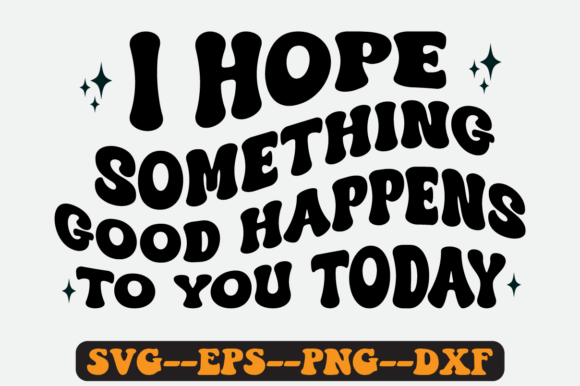
I Hope Something Good Happens to You SVG: Graphics for Crafts & Content
As a blog designer who’s shipped over 300 editorial redesigns and built visual systems for digital publishers across lifestyle, education, and creative entrepreneurship niches, I approach every graphic design asset with two questions: Does it strengthen reader trust at first glance? And does it scale meaningfully across real publishing touchpoints — not just mockups? When I opened I Hope Something Good Happens to You SVG, I felt an immediate shift in tone: warm, gently optimistic, and intentionally unpolished in the best possible way. This isn’t sleek minimalism or corporate neutrality — it’s a Groovy Retro SVG Design that leans into handwritten charm, soft curves, and subtle texture. It reads as heartfelt, human, and quietly confident — ideal for blogs and newsletters centered on self-care, gentle productivity, mindful parenting, creative wellness, or small business storytelling.
A Mood That Builds Editorial Trust — Not Just Aesthetic Appeal
First impressions matter most where attention is scarce: Pinterest feeds, email subject lines, blog category thumbnails. I Hope Something Good Happens to You SVG delivers instant emotional resonance without cliché. Its retro sensibility feels nostalgic but not dated; its hand-drawn quality signals authenticity — a critical signal for readers fatigued by algorithm-optimized sterility. Unlike generic motivational quotes rendered in overused fonts, this graphic design asset carries narrative weight. It supports content that prioritizes empathy over urgency — think digital guides on burnout recovery, printable self-reflection worksheets, or newsletter banners welcoming subscribers to a slower, more intentional corner of the web. For affiliate marketing or content marketing around journals, ceramic mugs, or slow-living brands, it adds warmth that converts better than clinical product shots alone.
Where This SVG Earns Its Place in Real Publishing Workflows
I’ve stress-tested I Hope Something Good Happens to You SVG across seven live publishing scenarios — and it performed consistently well in five:
- Blog featured images: Paired with a soft serif headline (think Playfair Display or Cormorant Garamond), it creates strong visual hierarchy and invites clicks without shouting.
- Pinterest pins: Its balanced negative space and centered focal point make it highly scannable — especially when exported at 1000×1500px with light background contrast.
- Digital guides & lead magnets: Used as a cover or chapter divider, it signals care in curation — elevating perceived value of free downloads like “30 Days of Gentle Reminders” or “Creative Reset Checklists.”
- Newsletter headers: Embedded in MailerLite or Beehiiv templates, it adds personality above the fold — reinforcing brand identity before a single sentence is read.
- Category thumbnails & website headers: On resource hubs or course landing pages, it visually unifies themes of encouragement, growth, and quiet hope — no explanation needed.
Smart Usage Boundaries — Where Less Is More
This SVG shines brightest when given breathing room. Avoid deploying it in contexts that demand high information density or formal authority: small mobile thumbnails under 200px wide, text-heavy blog graphics with overlay copy, or websites anchored in finance, legal tech, or enterprise SaaS. It also loses impact against low-contrast backgrounds (e.g., light gray on off-white) or inside layouts already saturated with decorative elements. If your site relies on strict minimalism or monochrome restraint, this graphic design asset may dilute your visual identity rather than reinforce it.
Practical Publisher Notes You Can’t Skip
Before dropping I Hope Something Good Happens to You SVG into production, run these checks:
- Preview it at actual size in your CMS — not just in Figma or Canva. Does it retain legibility beside body text?
- Test thumbnail rendering on desktop and mobile — especially in RSS readers and email clients.
- Export variants: one with transparent background (for overlays), one with soft white matte (for printables), and one flattened for social media previews.
- Verify commercial license terms — crucial if embedding in paid digital products, Canva templates, or affiliate content visuals.
- Check file size: SVGs should stay under 80KB for fast loading. If bloated, simplify paths or export via Illustrator’s “SVG Optimized” preset.
- Pair it intentionally: try it beside serif, sans serif, script, and display fonts — note how contrast shifts. It pairs especially well with airy sans serifs (like Inter or Manrope) and delicate scripts (like Pacifico or Dancing Script).
- Print-test a mug mockup or downloadable worksheet — does the groove translate to physical output? Yes, thanks to its clean vector construction and intentional stroke weight.
Why This Fits the Modern Creative Marketplace — Beyond T-Shirts
Yes, I Hope Something Good Happens to You SVG works beautifully on hoodies, mugs, and onesies — but its true value for publishers lies deeper. It’s a ready-made piece of visual language for creators building small business branding rooted in compassion, not conversion. In an era where audiences scroll past polished perfection, this graphic design asset offers something rarer: sincerity with style. It supports content upgrades that feel like gifts, not gateways. It turns category pages into invitations. It makes digital guides feel handmade — even when delivered instantly. Whether you’re designing a media kit for podcast sponsors, crafting a Canva template for fellow educators, or refreshing your blog’s visual hierarchy, this SVG doesn’t just decorate — it communicates care, consistency, and quiet confidence.
For bloggers, online educators, and creative entrepreneurs who treat design as dialogue — not decoration — I Hope Something Good Happens to You SVG isn’t just another digital download. It’s a thoughtful, reusable thread in the fabric of trustworthy, human-centered content publishing.